
By Michelle Wilband
This toast was offered at the Works of Robert Crouse Halifax Book Launch in February 2024.
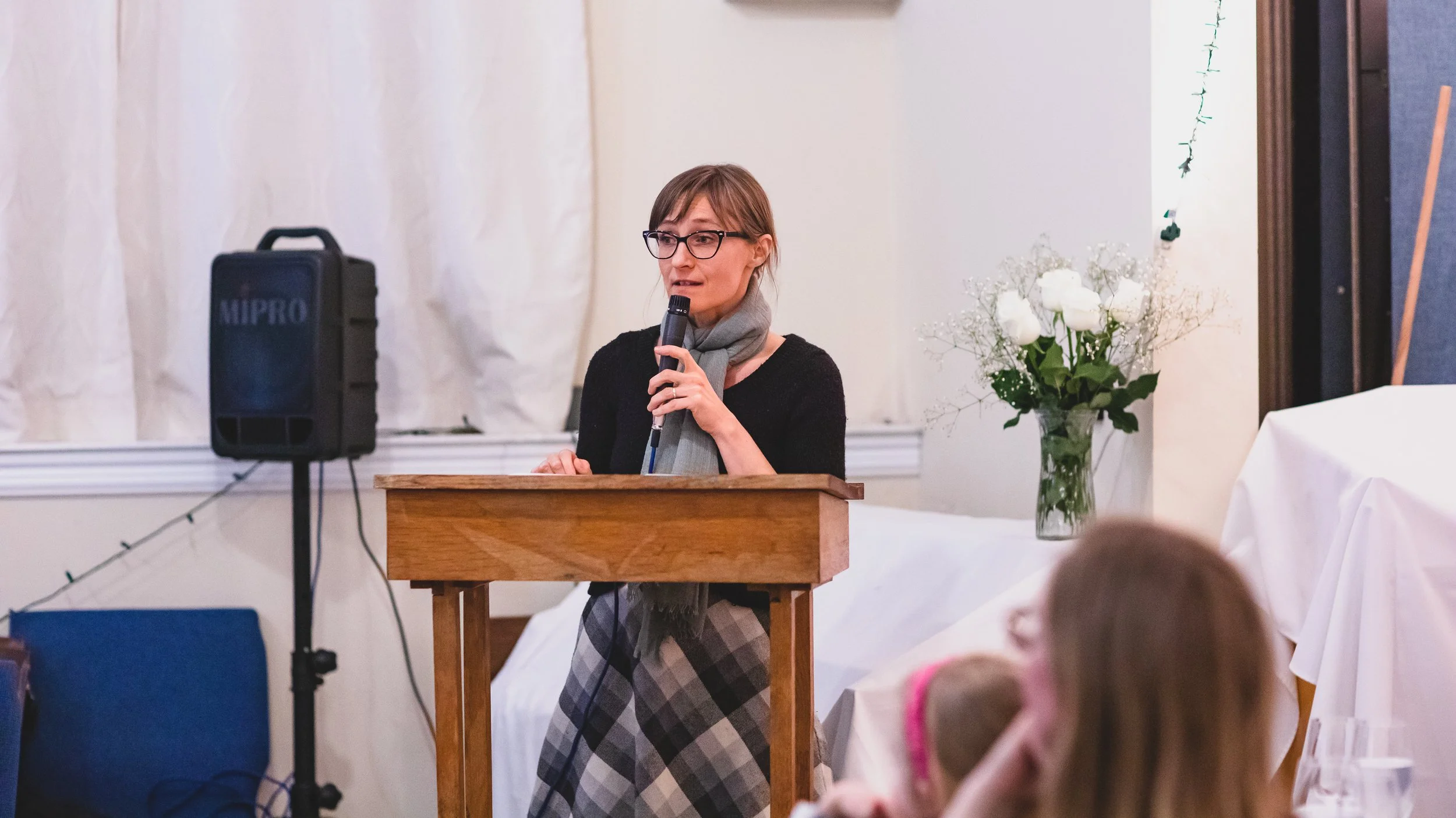
So here we are at the end of this so-called “book launch” – end in the sense of terminal point, maybe also in the sense of final purpose – a banquet in honour of the speakers who’ve been gathered here these last two days. The talks have been truly extraordinary. Everything I might have liked to say now, and more, has already been said, and more truthfully and beautifully than I could have said it. Still, I’m here and I have to speak. So I’ll begin just by noticing that this event has made for a rather unusual book launch. For one thing, this is the third location in the city that’s hosted our event. In fact, it seems to me that it’s not been simply an event, but many events in one – it’s been an academic conference, also a kind of devotional retreat, a reunion of old friends, even a shared musical aesthetic experience – all unified and integrated into this single event that we’ve been calling “the book launch.” I do think I detect an almost Trinitarian diversity in unity and unity in diversity lurking in the very structure of this event. And if I’m right, this would be a fitting form for the launch of these volumes, reflecting, as it does, the coherent integration of distinct elements in Father Crouse’s thinking, and the Trinitarian focus of his remarkable life’s labours. Adding to this Trinitarian theme, now we’re banqueting the event’s speakers, who, themselves diverse and distinct, have come together in this event, as a community, in the unity of conversation, and in a shared debt to Father Crouse and his legacy.
One thing that the event’s speakers – taken all together – have demonstrated, is that Father Crouse was an exceptional teacher. As we’ve seen over these last two days, his gifts as a teacher continue to be proven and realized in the ongoing work of his many students. Crouse, as we all know, exercised his rare and fruitful talent for teaching both in the church and in the academy, apparently finding no conflict between these two spheres of his work, no discord between the operations of faith and intellect. From my perspective as a teacher in the secular classroom, this integration and interpenetration of faith and intellect has seemed one of the most striking, and (perhaps oddly) relevant, features of Father Crouse’s work. It certainly struck and surprised me when I first encountered him as a student, and left a permanent mark on my own understanding of what a genuine education consists in.
I first became aware of Father Crouse, and came into the sphere of his influence, more than 20 years ago now, when I was in my first year of studies at St. Thomas University in New Brunswick. Outside of class, a professor at St Thomas – himself a student of Father Crouse – had given to me and my then-boyfriend Dan Wilband a short paper to read called “Heavenly Avarice: The Theology of Prayer,” which Crouse had delivered at a conference a few years earlier. That jewel of a paper was our introduction to Father Crouse and to the ascetic simplicity and translucid clarity of his writing – which I’ve heard many remark upon during this event – and it was the beginning of a long term encounter for us, and appreciation of his work. After this followed a tall stack of photocopied sermons, and eventually scholarly theological papers – and in this way, without ever having met him in the flesh, Father Crouse had become one of the formative teachers of our undergraduate years.
After this, Dan and I – by now married – made our way to study in the Classics Department at Dalhousie, too late to take any classes with Father Crouse, but still in time to hear him deliver papers, to attend services and talks with him on the South Shore, to hear him play the organ, and to visit him in his beautiful home. We never came to know Father Crouse nearly as well as so many others here, but we did treasure our interactions with him, however few.
It was no doubt a great gain for both Dan and me to have had the direct contact with Father Crouse that we did, but still I think it’s worth emphasising the impact he’d already had on us before this, indirectly, through his writing. His writings by themselves had already helped to inform the course of our educations, and they can still do this for others who’ll encounter these volumes, with the added advantage that their aesthetic appeal is far higher than the Xeroxed copies of the old days. But in actual fact, it was not Father’s Crouse’s writings on their own that affected us. My and Dan’s early encounter with Father Crouse’s work as students didn’t take place in a vacuum, but in a context, in relationship –both with each other, and with teachers and friends who had themselves been shaped by Father Crouse’s work. Crouse’s influence became stitched into the fabric of our lives because of the conversations and the friendships that drew us into a wider intellectual and spiritual community. Not to say that this was at all points a smooth and agreeable process, or without strife, and some of the best learning surely came through an experience of trial and failure. Nevertheless, this context of living friendship and conversation, of community, – for all its frailty and fallibility – was, I think, indispensable for us, and I think it embodied something essential about both the methods and the purpose of true education.
Not that I learned from Father Crouse to confuse the classroom with the church, or to conflate a liberal education with catechism –a conflation that in practice would surely suppress the intellect and impoverish faith. And without question even the most secularised classrooms can suffer from just such a conflation and impoverishment and suppression, though their dogmas be of another order. Father Crouse often had recourse to the Thomistic maxim that grace does not destroy nature. Neither, then, does faith destroy the freedom and integrity of the intellect. [Nor is it threatened by it.] The harmony of intellect with faith in Father Crouse’s teaching and writing, along with the leitmotif of friendship in his work, helped to make visible, for me, a fully human vision of education – one that embraces the intellect in earnest, in its natural integrity, and that addresses the student in their complete relational personhood, and in their highest end.
I recently returned to that very first Crouse paper I’d read, “Heavenly Avarice: The Theology of Prayer,” and I was struck again by the quiet power of Father Crouse’s writing, and I could easily see why it moved a couple of ordinary university students, like Dan and I were. We were entirely typical undergrad students – newly free of parental restraints on our desires and encountering new intellectual worlds – and that paper spoke directly to the stirring of desire and intellect in which we found ourselves. The paper spoke of desires – our desires –in a way that took them seriously, without belittling or moralising them, and at the same time it spoke with a startling intelligence and intellectual credibility about God and about prayer. Quote:
All human desire, all human longing and aspiration, expressed in a thousand different forms, at a thousand different levels, is ultimately desire for God,
So we read in the first paragraph,
My soul is athirst for God.
The paper goes on to distil the apparent chaos and variety of the heart’s desires into an intelligible threefold longing for the truth, goodness, and beauty of God in all things. These three are then resolved into one fundamental (if hidden) human longing – the deep-rooted desire for the transfiguring intimacy of divine friendship. Citing philosophers and poets alongside scripture, the paper was able to tie the intellectual content of our classroom studies to the movement of the heart’s deep desires, and it pointed to the fulfilment of both in a living reciprocal encounter it was calling “prayer.” “Prayer is the activity of love’s conversion,” it said. “[...] Prayer is the conversation between intimate friends.” That paper gently overturned a host of confused assumptions about Christianity, about tradition. It also hinted at the full promise, and also the limits of a humanities education. And it did this without gimmick, without manipulation, or coercion. Crouse’s words had the simple, clear, and humble ring of truth.
May the humble truth ring out in these volumes, and in the conversations and friendships that will give them life. It’s my sincere pleasure to toast the event’s outstanding speakers, who have so admirably launched them these last two days. And I hope we all enjoy this end of the book launch– this banquet in their honour– as a community of friends, knit together, however imperfectly, in that “supernal triune love” that Father Crouse steadfastly preached and adored.