
By the Rev’d Dr. Walter Hannam
Fr. Hannam is the Vicar of St Bartholomew’s Anglican Church in Regent Park and an Associate Priest of St James Cathedral. He is also Adjunct Professor of Ecclesiastical Faculty of Theology at St. Augustine’s Seminary.
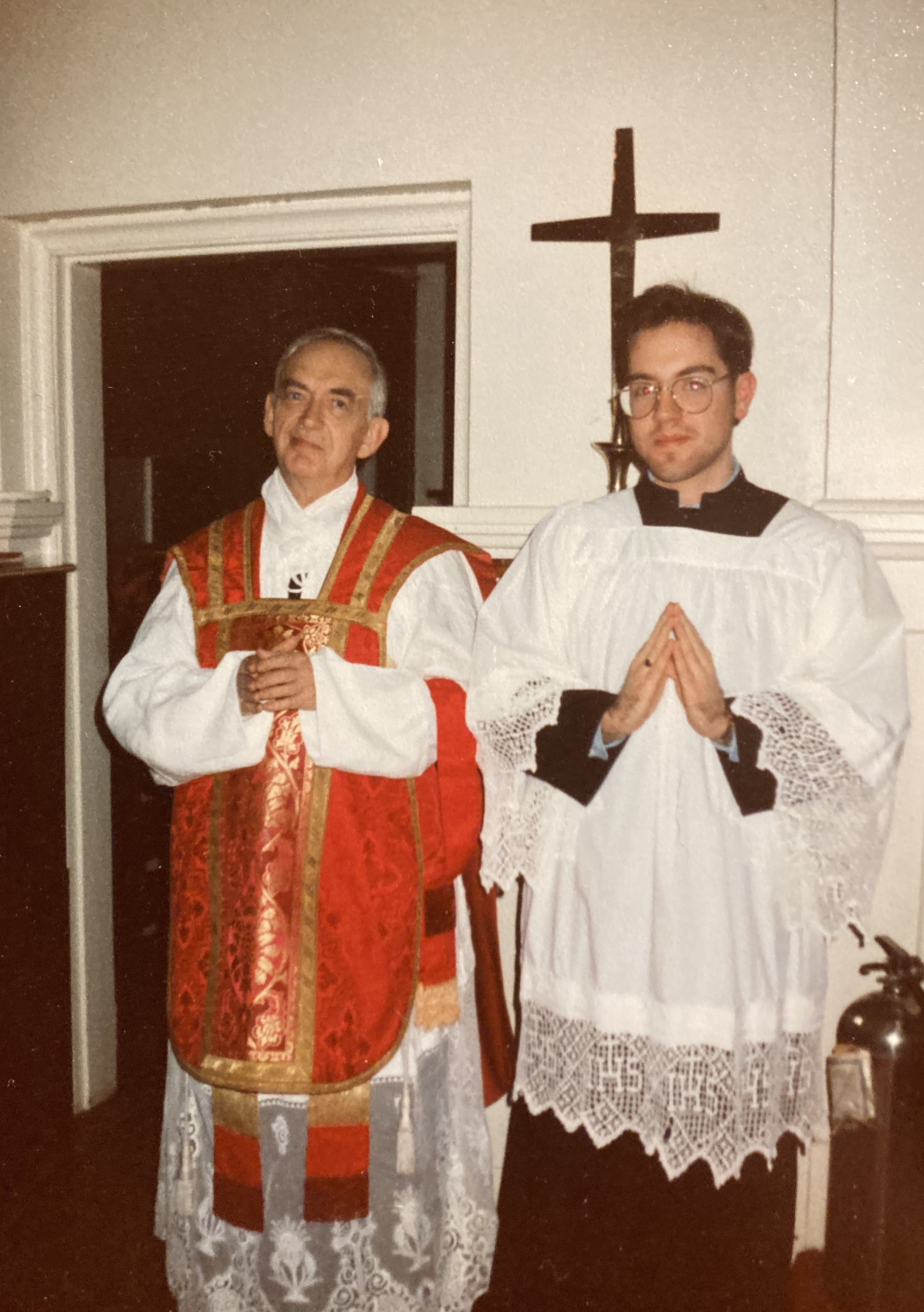
I arrived at the University of King’s College in the fall of 1990 to begin the studies that I hoped would lead to my ordination as a parish priest of the Anglican Church of Canada. Two degrees later, I left Halifax, in the fall of 1997, bound for doctoral studies in theology at Boston College. What had changed in those seven years was not my sense of vocation to the priesthood — if anything, that sense of call had deepened and intensified; what had changed was my sense of what I thought my preparation for that ministry ought to be. My time in Halifax had broadened my understanding of the Church — ancient, mediaeval, modern; Catholic and Reformed — beyond anything I might have imagined on my arrival. More specifically, I had grown to love the Church’s theological tradition, grounded alike in the study of Sacred Scripture and Greek philosophical speculation. It was a vision of the Church of compelling beauty, truly universal in its scope of interest and in its comprehension of all that can be called true or worthy of human aspiration. That vision was embodied for me and for my fellow students in the teaching and example of Father Robert Crouse.
Perhaps the most compelling aspect of Father Crouse’s teaching about the Church and her speculation was his account of the Augustinian tradition, to which Anglicans, together with the rest of the Western Church (both the Roman Catholic Church and the Churches of the Magisterial Reformations), stand as heirs. As Father Crouse explained it, Augustine’s theology was a Christian ‘conversion in principle’ of Platonic philosophy, which had sought to explain the existence and significance of the sensible, particular world in relation to a unitary first principle understood as the ground of existence and thought. In his Confessions, St Augustine tells us that his Christian conversion had been mediated by a prior conversion to (or turning towards) God, the principle or cause of his being, life, and thought, through the reading of certain books of unnamed pagan Platonists. In these books, he says, he discovered two things of immense importance. In he first place, he learned that God has a logos — an intelligible expression or Word — which is the determining principle of all existent things. Just as importantly, however, these books also prompted Augustine to examine the nature and form of his own consciousness in light of this principle. What Augustine discovered was that his own thinking was literally unthinkable apart from such a principle as the Platonic books had described; the divine logos, he realised, was the indubitable axiom without which his own thinking could neither be explained or thought.
Yet Augustine did not accept the doctrines of Platonism uncritically, as Father Crouse was at pains to show. Rather, Augustine’s specifically Christian Platonism was in a constant state of revision and correction throughout his life. Specifically, Augustine discovered in the Christian Scriptures a self-disclosure by this same divine logos, now become human, which became a new and more adequate starting point for his investigation of creation’s first principle. In Scripture, God’s Word-made-flesh revealed himself not, as in pagan Platonism, a principle subordinate to God, but rather as God’s own immanent knowledge of himself. Through rational reflection upon the Scriptural witness to this revelation, the Church had come to understand the Persons or hypostases of the Trinity — Father, Son, and Holy Spirit — as specific relations within the one activity that is the divine life.
Yet Scripture also disclosed to Augustine his own human consciousness — itself a triformal activity of self-conscious being (or memory), knowing, and willing (or love). As such, this conscious activity stands as the created image of the triune God, which can be perfected only insofar as it attains the vision of its uncreated architype and of all creation in that archetype.
Augustine’s ongoing Christian conversion, which was itself the ongoing conversion of Platonic philosophy in Augustine’s thinking, consisted in a deepening of his understanding of the first principle, and of himself as the created image of that eternal triune life, in an ever-deepening consciousness of himself as memoria dei, intellectus dei, voluntas dei. Augustine’s initial Platonic conversion had disclosed to him a creative divine logos, apart from which both his thinking and being were unthinkable; his ongoing rational engagement with that same logos — now speaking to him in the Scriptures and in the Church’s dogmatic pronouncements —resulted in a rational demonstration that the Trinity is the only principle adequate to explain the triformal activity that is human consciousness.
This specifically Augustinian Christian Platonism, as received in the late-Roman and mediaeval periods, issued in two distinct, though complementary and often interpenetrating, forms of spirituality or mysticism. The first form is ‘immediate’ and entirely ‘interior’, consisting simply in the mind’s turning away from sensible particularity to the examination of its own inner life, which it judges unthinkable apart from an immutable grounding principle that is itself the identity of truth and existence.
The second form of Augustinian spirituality develops from the discovery of the full divinity of God’s Word. If the creative logos is God’s consubstantial (and therefore complete) expression of his own ‘interior’ or immanent life, then the whole created universe must be recognised to be revelatory or ‘theophanic’. The ninth-century philosopher John Scottus Eriugena drew this form of Augustinian spirituality into a creative synthesis with the Christian Neoplatonism of the fifth century Syrian author, Dionysius the Areopagite. This ‘Eriugenian synthesis’ was immensely influential in the intellectual development of the West.
In this second, Eriugenian, form of Augustinian spirituality the soul’s ascent to contemplation of its divine ground is mediated by prior operations of human consciousness. This mediation begins as the soul examines the data of sense perception as received by imagination. The primary sensible forms to which attention turns are the given words and images of holy scripture, which must be accepted in faith, on the authority of the Church. Since the sensible and intelligible universe — which Augustine calls variously the ‘universe of things’ (universitas rerum) or ‘God’s republic’ (res publica Dei) — has been shown to be the theophanic expression of God’s consubstantial, coeternal Word, however, the soul’s ascent to its divine principle can also begin with the contemplation of it.
For Augustine, true belief, in the sense of right opinion (and chiefly right opinion authoritatively given by the divine Word in Scripture through his Church), is simply knowledge in its undemonstrated form. The appropriation of the words and images of Scripture (or of the created cosmos understood in relation to its cause) by imagination and faith, therefore, gives way to a new and more adequate knowledge or science (scientia), as reason (ratio), examining the authoritatively-given words and images of Scripture (or created beings in relation to their cause) in light of its own universal categories, discovers the universal truths that these words and images mediate. It is on the basis of this renewed science that mind ascends beyond the discursive activity of reason (ratio) to the intuitive grasp of its principle in wisdom (sapientia) by understanding (intellectus or intelligentia).
Of course, these forms of spirituality should never be understood as standing in isolation from one another. As Augustine explained in his Confessions, the immediacy of his Neoplatonic vision of the truth was inadequate to human aspiration apart from the discovery that the incarnate logos, grounded in the triune activity that is God, is not only our end or homeland (patria), but is also itself our way to that homeland. The vision attained in immediacy is certainly true, yet in its immediate form it is fleeting and transitory; God and his logos are seen as the essential presuppositions of human consciousness, but the essential mutability of that consciousness renders impossible the sustained continuation of the vision. Only the renewed science of creation and of the triformal unity of human activity — memoria, intellectus, voluntas — as “a certain portion of that creation” (Confessions, 1.1) is adequate to the renewal of human rational appetite or will, which alone can draw the human person concretely to the vision and enjoyment of our first principle. And only the renewal of our memory through our ongoing engagement with the incarnate Word speaking outwardly in Scripture and proclamation renders possible this conversion of the interrelated and interpenetrating powers of understanding and will.
It is this Augustinian theology of conversion, that stood behind the whole mediaeval liturgical tradition, the essentials of which have been preserved in the rites of the classical Books of Common Prayer. Father Crouse clearly demonstrated and defended the centrality of the Prayer-Book to Anglican spirituality in countless presentations, articles, and sermons. In that “spiritual system,” for example, the Church’s ancient eucharistic lectionary presents the saving knowledge of Christian revelation to our memory in what Father Crouse described as a “supremely logical form,” which aids the reason in its meditation or rational reflection. The logic of this presentation is itself governed by the Church’s doctrinal tradition, which is also the very logic of Scripture itself, when read according to its own principles. Reflection on the Scriptural images according to that logic leads the mind to an ever-deepening knowledge of spiritual reality. That science, which tends under the influence of God’s grace to the acquisition of wisdom, is itself the ground of the renewal of our wills, as our many disordered loves are redirected to the enjoyment of God in himself and of creation as found in God and ordered to God.
There is much more that might be said about the Augustinian tradition and its influence on Classical Anglican liturgy and theology which cannot be dealt with in a short article. This digest of insights drawn from Father Crouse’s writings only begins to scratch the surface of the remarkable treasure-house of scholarship and spirituality that he has left to us. I will simply conclude by saying that after just over two decades of parish ministry and seminary and university teaching, I am more convinced than ever that a recovery of the Augustinian intellectual and spiritual tradition must stand at the centre of any genuine renewal of the Western Church, and I am also convinced that, for Anglicans, this must involve first and foremost a rediscovery of the classical Prayer-Books. In all of this, we could ask for no more faithful interpreter and guide than Father Crouse, and it brings me great joy to know that his writings are now being published in a form that will both continue to nourish those who are already his students and allow his thought to be introduced to those who might otherwise never have known of this remarkable priest, teacher, and friend.