
By Karis Tees and Hannah Griffin
Karis Tees lives in Halifax with her husband Will and two children, Everett and Madelaine. She serves as Director of Music at Trinity Anglican Church and is a singer-songwriter (karisteesmusic.com).
Hannah Griffin is an arts administrator for Capella Regalis Choirs and a graduate of the University of King’s College. She holds St Anne’s Camp dear to her heart as the place of many an experience of theophany over the years — both as a university student attending Chapel retreats, and now as a wife and mother attending Penny In The Dust Family Camp.
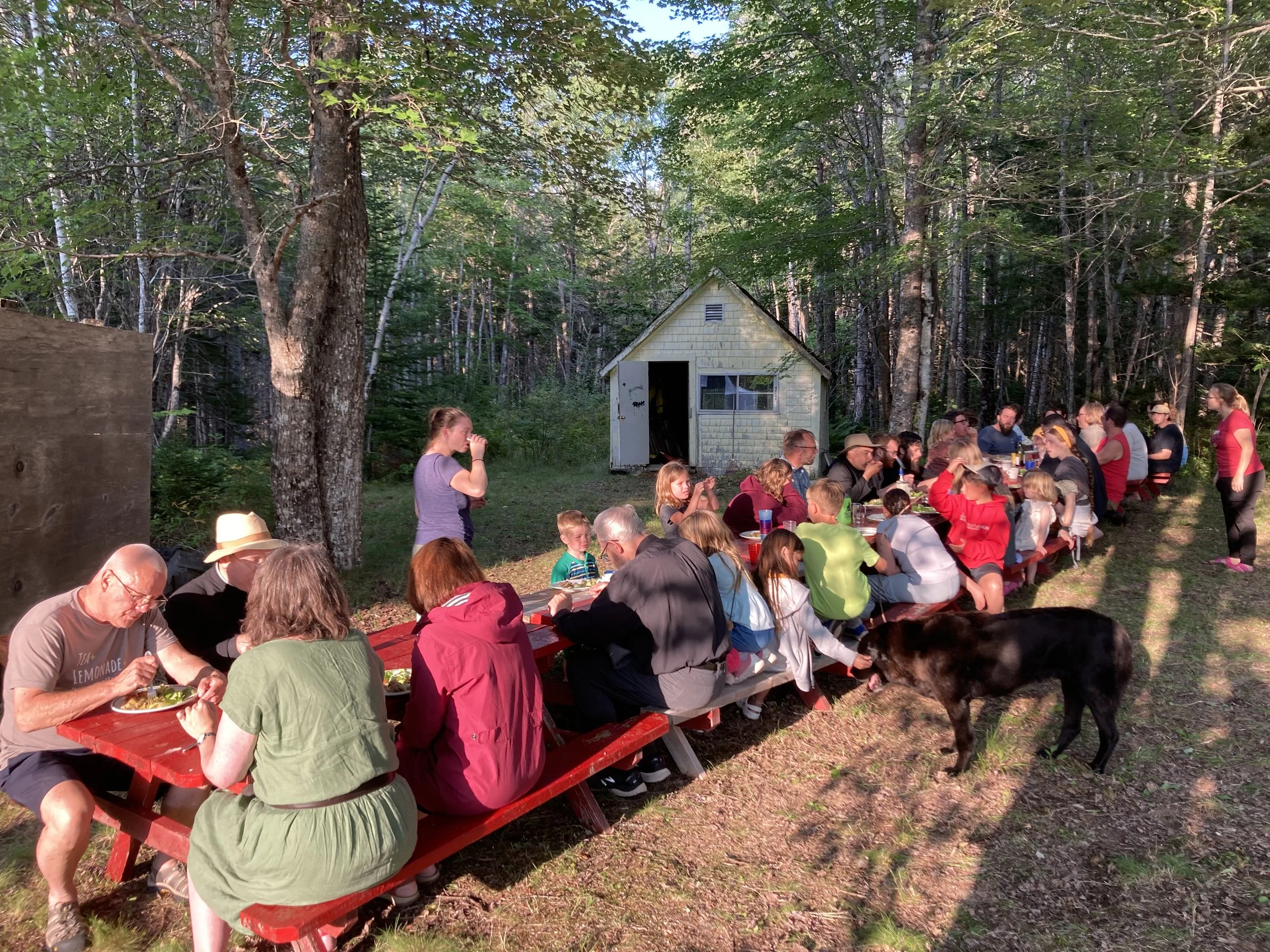


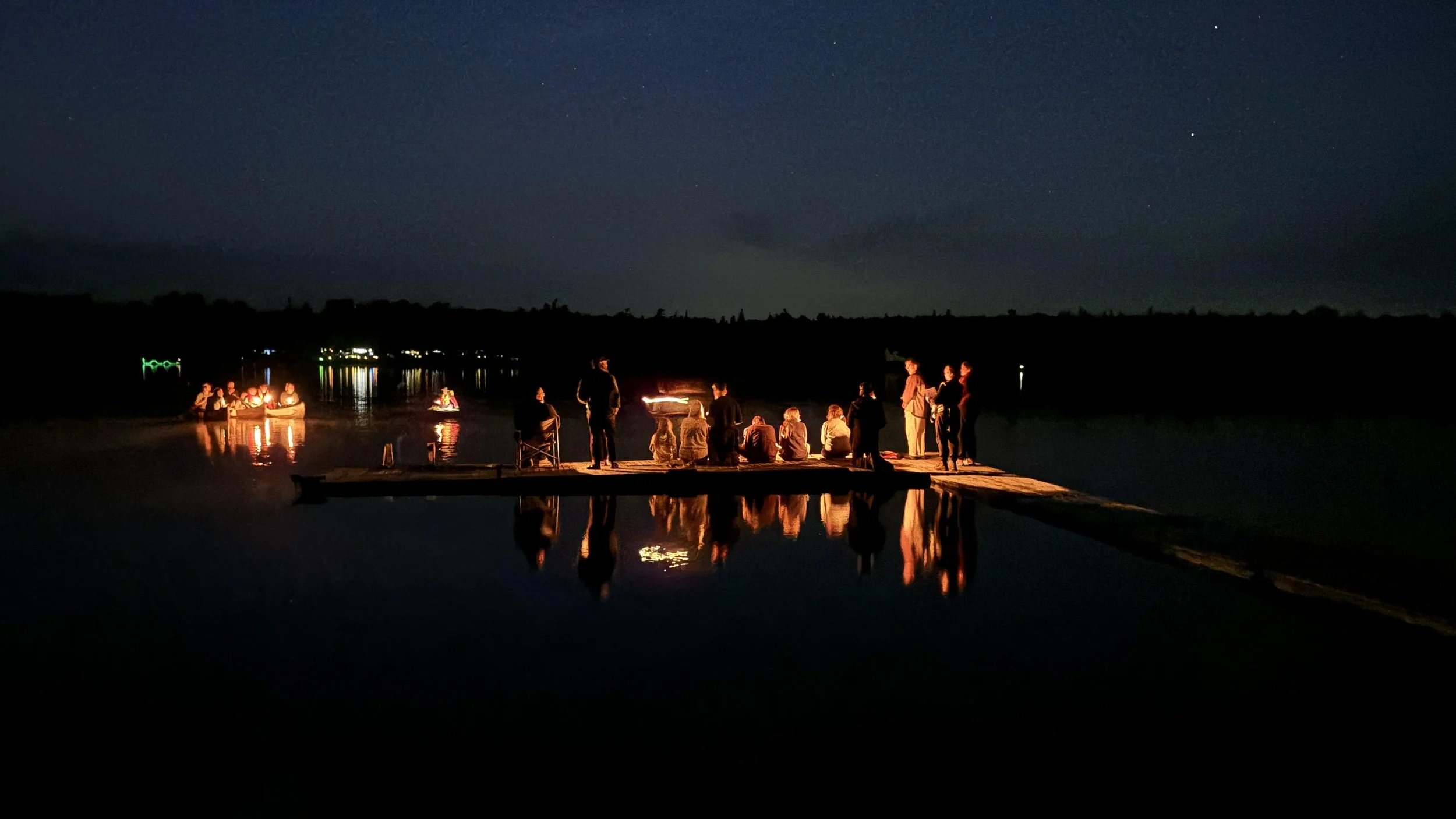


“Be ye not conformed to this world, but be ye transformed by the renewing of your mind.” Romans 12:2.
‘The Penny in the Dust Family Camp’ is a living and lively branch of the Works of Robert Crouse project. Our family camp invites parents, children, and friends into the backcountry woods of West Dalhousie to pray the threefold Regula of Private Prayer, the Daily Offices, and the Eucharist, inviting the renewal of our minds, setting our sights on the vision of heavenly glory that overflows in the created order, and drawing us in to a contemplative adoration of its Creator.
Holy Communion is offered each day before breakfast, just a short walk or paddle from the cabins (the loon and hermit thrush are our alarm clocks). Families gather daily to pray the offices of Morning, Noonday, and Evening Prayer together (at least, we begin to pray all together, before the littlest wander out to dig or draw, and a few grown-ups follow their lead).
Also at the daily offices, camp organizers and participants give personal meditations on the scripture lessons. In this way, family members make it possible for each other’s individual members to receive the spiritual gifts that sustain us.
Tales from the Children’s Side
The first year of Penny in the Dust, Andrew Neish catches a big fish straight off the dock on his first try with just a stick, some fishing line, and a hook. Fr Benjamin Lee cooks it up with foraged chanterelles to share, as he does when Brendan Lee’s patience is rewarded with three small trout. The second year, Andrew catches a bullfrog and he and his companions parade ‘Bully’ around the camp in the net, and Molly and Mary host a multi-day slumber party for the littles on the shady grass. Each morning at breakfast the children mix their own (very chocolatey) cups of hot chocolate, and again after Compline, for those who are still awake. The teens and tweens spend most of their time in the lake, defying fears of a snapping turtle sighted near the dock, floating for hours on a swamped canoe. At night, one of them dreams of the answer to the most important question in the world – only to find that both question and answer disappear upon waking. The icon banner of St George comes with us wherever we go, carried by an Angel: to All Saints Church across the lake, to the outdoor chapel, to daily prayers in the Kaulback building, to the meal hall, and to the graveside of beloved writer Ernest Buckler, author of the ‘Penny in the Dust’ story for which our family camp is named.
“There were many times during each day of the camp that people would just gather by the lake or at a table or even on the field and just relate to one another about everything, the good and the bad, the pain and the relief of living in this world while being Christian. I describe Penny in the Dust as a key that unlocks a whole new feeling. I do not mean a feeling of happiness or a feeling of love, I mean a feeling of God’s hand resting in my shoulder and filling me with his compassion.” – Mary Neish, age 14
Last year, in August 2024, more than a dozen families gathered at St. Anne’s Camp on Gibsons Lake, West Dalhousie, Nova Scotia for the first ‘Penny in the Dust’ camp. This was a gathering born out of a mutual need for friendship, especially among families seeking to be true to their own conversions by Goodness, Truth and Beauty, determined to nurture our children in a home life sustained by a pattern of daily prayer in tune with the Wisdom of the Ancient church and adequate to guide our children into adulthood in our harsh, confused and broken world.
Well, that is rather easier to say than to do! The way of the world is to insist that family life is ‘too busy’ – we do not have time to write that needful letter to a friend or have that phone conversation we’ve been putting off. Certainly we do not have time or energy to pray daily with our children (we are so tired!). But Fr Crouse reminds us, with St Paul: ‘Be ye not conformed to this world, but be ye transformed by the renewing of your mind.’
In addition to the daily rhythm of prayer, we have embraced guest teachers and preachers, including: evening talks on the correspondence of the writings of Ernest Buckler and Robert Crouse by Fr Walter Hannam (Vicar of St Bartholomew’s Toronto) and afternoon meditations on the poetry of Thomas Traherne, George Herbert, and R.S. Thomas by local scholar-priests Fr David Curry, Fr Ranall Ingalls, and Fr Peter Young.
Beyond this, as the camp’s web description reads, ‘There is a whole lot of free time for canoeing, campfires, activity, conversation, and friendship. Caught lake trout are to be grilled and shared by all!’
We practice a ‘generous Anglicanism,’ following the ascetic discipline of the ancient and contemporary prayer book tradition, described faithfully in the writings of Fr Robert Crouse. Holy Communion and the Daily Offices lay out for us a Way of salvation that works in us day by day in reading and meditating on Holy Scriptures.
Ah, but surely family life (human life) is too materially messy to be part of this way of sanctification! Can it be true that our day-to-day household life, with its anguish, doubt, discovery, conflict, fatigue, demands, and tenderness so sweet it hurts, can itself be the road to the Cross, the way of humility and sanctification?
In a meditation on the Evening Prayer lessons during the first year of Penny in the Dust, Duncan Neish answered this question with a hearty, good-humoured ‘Yes!’, reminding those of us that are tempted to bitterness and hardness of heart that parenthood is surely a road to humility, a golden opportunity to ‘die daily’ in the giving up of self for others, our spouses and children.
Each year we are nourished with readings from sermons and texts from the entire tradition. In year two, family campers were reminded by St Andrew of Crete (7th century) that worldly busy-ness is not a new problem: ‘Often we are not permitted to form even a vague image of those blessed intelligible visions, since our intelligence is dominated by its attraction towards sensible things, and therefore our hearts find it difficult to desire what is ultimately desirable’ (On The Transfiguration of Christ our Lord). At Penny in the Dust Camp, in worship and in conversation, families seek to remind one another of our heart’s true desires, even as we share many aspects of the sensible realities of everyday life.
If the initial idea for a family camp was born of the mutual desire for friendship among Anglican families and households feeling lost in this world, the revelation of Penny in the Dust Camp is that the friendship we desire is Divine Friendship, and that this friendship has found us. It remains for us to encourage one another to live by the vision of heavenly glory that once hailed each of us, and hails us still. Indeed, Penny in the Dust Camp is grounded in memory and in hope for the 21st century. Mark your calendars! Next year’s camp will take place August 2 – 8, 2026.